I give up!
Some time ago I found an oil flow diagram and what I believe to be the location of the switch.
Now I can't find either.
Anybody point me in the right direction?
I believe I've read it's at about 2:00 from the oil level window?
Not real light in the garage, but couldn't ID it when I looked.
Thanks!!
Oil Flow Diagram & Pressure Switch
Moderator: Moderators
-
boxermania
- Quadruple Lifer
- Posts: 3644
- Joined: Thu Mar 17, 2005 6:37 pm
- Location: Baton Rouge, LA.....aproaching retirement
Re: Oil Flow Diagram & Pressure Switch
Under the left cylinder.....right above and to the right of the oil window
http://picasaweb.google.com/lh/photo/YU ... directlink
Hope it helps.........
http://picasaweb.google.com/lh/photo/YU ... directlink
Hope it helps.........
Member #312
06 Suzuki Burgman 650 "state of flux"
79 CBX
06 Suzuki Burgman 650 "state of flux"
79 CBX
-
TracyPrier

- Basic User
- Posts: 42
- Joined: Thu Jan 15, 2009 7:04 pm
- Location: Auckland, New Zealand
- Contact:
Re: Oil Flow Diagram & Pressure Switch
Yep...dat's it 
I'm going to install a brass T piece so I can add an oil temp sender
cheers
Tracy
I'm going to install a brass T piece so I can add an oil temp sender
cheers
Tracy

It's Already There
Ironic that all our bikes have one.
If only we could tap on to the signal for the Motronic and read it!
If only we could tap on to the signal for the Motronic and read it!

-
CycleRob

- Honorary Lifer
- Posts: 2857
- Joined: Mon Mar 21, 2005 12:29 am
- Location: Enjoying retirement in Gainesville GA. USA
- Contact:
Re: Oil Flow Diagram & Pressure Switch
"If only we could tap on to the signal for the Motronic and read it!"
Your dash's red oil pressure lite already reads it. The pressure switch only contains a make/break pressure switch at about +4psi.
The temp switch adjacent to the oil cooler thermostat is the one worth "tapping into" but I don't think the Motronic would tolerate the "sharing" of temperature information.
Your dash's red oil pressure lite already reads it. The pressure switch only contains a make/break pressure switch at about +4psi.
The temp switch adjacent to the oil cooler thermostat is the one worth "tapping into" but I don't think the Motronic would tolerate the "sharing" of temperature information.
`09 F800ST
Member since Sept 10, 2001
"Talent, On Loan, From God" --Rush Limbaugh--
Member since Sept 10, 2001
"Talent, On Loan, From God" --Rush Limbaugh--
-
boxermania
- Quadruple Lifer
- Posts: 3644
- Joined: Thu Mar 17, 2005 6:37 pm
- Location: Baton Rouge, LA.....aproaching retirement
Re: Oil Flow Diagram & Pressure Switch
I agree as these switches are nothing more than a variable resistor, where the resistance changes as a function of temperature and a pre-selected applied voltage changes as resistance changes. The ECU is programed to see the voltage changes as temperature changes.The temp switch adjacent to the oil cooler thermostat is the one worth "tapping into" but I don't think the Motronic would tolerate the "sharing" of temperature information
One could set up a simple experiment......with a digital VOM (high input inpedance so as not to load the circuit) tap onto the signal and record the range of voltage during bike operation. Then remove the sensor and generate a curve of resistance vs temperature in your spouses kitchen, using her pots under a verbal barrage of getting oil and dirt on her kitchen.....under the auspices that she will throw out everything used for the experiment, which you will replace in kind.
Then obtain a rangeable 3 1/2 digit readout that accepts DC voltage as an input and is powered externally......
Ahhhh way too much fun, I think I'll tap off the main gallery..............

Member #312
06 Suzuki Burgman 650 "state of flux"
79 CBX
06 Suzuki Burgman 650 "state of flux"
79 CBX
Re: Oil Flow Diagram & Pressure Switch
Tracy said:
Charlie
I think more than a couple of us would really appreciate getting some details and seeing some pictures of your install if at all possible. Having an oil temp gauge would really be useful but I'm a bit chicken to try tapping the blind hole that Cycle Rob used in his set up.I'm going to install a brass T piece so I can add an oil temp sender
Charlie
'03 R1150R
Life member 365
Errabundi Saepe, Semper Certi
Life member 365
Errabundi Saepe, Semper Certi
Re: Oil Flow Diagram & Pressure Switch
I've been wishing for both an oil pressure and temp gauge - have them on a couple of my
vehicles and it's surprising how much info it gives you as you're driving under diff conditions.
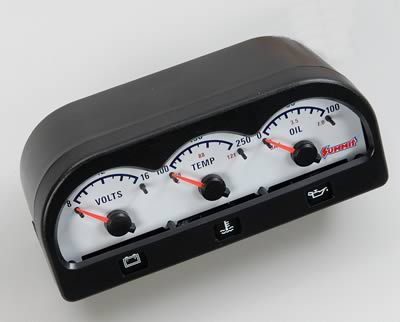
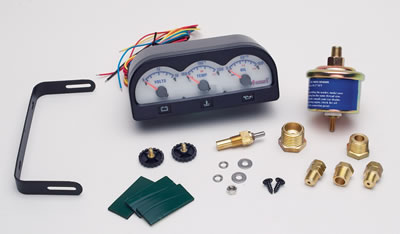
I found a neat little mini gauge panel on Summit for about $65, looks like it's enclosed and has
a mount with it that mite at least help mount it on the bars. I think it's like 5" long. Gauges are
1-1/2". http://store.summitracing.com/egnsearch ... ults=false
I was hoping I could put a T in at the oil pressure port and put the sender there for the gauges.
For oil temp, I've looked under the bike at the drain plug and have just about convinced myself
to give that a try. I don't do ANY gravel riding with my bike and when you think of it it's not a
whole not more vulnerable than lots of things on the underside of a car. If something would
happen to bounce up and screw up the sender, I doubt if it would do any other damage so the
oil would run out anyway. It would most likely give the most accurate temp reading too.
Found a Stewart Warner adapter - th the threads in the pan are M16x1.5 and SW makes a brass
adapter for a 1/8" electric temp sender. It would hardly stick down below the fins on the bottom
of the pan, and it would take a hit from something fairlymajor to hurt it, so think it would be
worth a try. http://www.sw-performance.com/index.php ... s&p=114851
Probly be a couple months till I try that, but I'll post if/when I do and with some pics.
vehicles and it's surprising how much info it gives you as you're driving under diff conditions.
I found a neat little mini gauge panel on Summit for about $65, looks like it's enclosed and has
a mount with it that mite at least help mount it on the bars. I think it's like 5" long. Gauges are
1-1/2". http://store.summitracing.com/egnsearch ... ults=false
I was hoping I could put a T in at the oil pressure port and put the sender there for the gauges.
For oil temp, I've looked under the bike at the drain plug and have just about convinced myself
to give that a try. I don't do ANY gravel riding with my bike and when you think of it it's not a
whole not more vulnerable than lots of things on the underside of a car. If something would
happen to bounce up and screw up the sender, I doubt if it would do any other damage so the
oil would run out anyway. It would most likely give the most accurate temp reading too.
Found a Stewart Warner adapter - th the threads in the pan are M16x1.5 and SW makes a brass
adapter for a 1/8" electric temp sender. It would hardly stick down below the fins on the bottom
of the pan, and it would take a hit from something fairlymajor to hurt it, so think it would be
worth a try. http://www.sw-performance.com/index.php ... s&p=114851
Probly be a couple months till I try that, but I'll post if/when I do and with some pics.
-
CycleRob
- Honorary Lifer
- Posts: 2857
- Joined: Mon Mar 21, 2005 12:29 am
- Location: Enjoying retirement in Gainesville GA. USA
- Contact:
Re: Oil Flow Diagram & Pressure Switch
Very nice. Where to put it is the biggest problem.
`09 F800ST
Member since Sept 10, 2001
"Talent, On Loan, From God" --Rush Limbaugh--
Member since Sept 10, 2001
"Talent, On Loan, From God" --Rush Limbaugh--

Re: Oil Flow Diagram & Pressure Switch
Monitoring engine oil pressure is good, and oil temperature even better, but caution is advised when teeing off the existing oil pressure port. These Tee's fail on boats that get the same jolts and vibration our motorcycles do. They probably fail due to the lengthened lever arm of the 1/8" pipe "T" base combined with the mass of the senders hanging off the end. To prevent any movement that could weaken and possibly break the mounting pipe, maybe you could secure the assembly. The subsequent loss of oil pressure that might otherwise occur could sieze the engine. 


Rich
ADIOS!
ADIOS!
Re: Oil Flow Diagram & Pressure Switch
If vibration failure is a concern, one might be able to use a stainless short nipple and T.
They'd be LOTS stronger.
As far as mounting location, I haven't physically measured, but I was thinking of mounting
on the bars between the risers, either between the risers or using maybe even the mount
bracket that comes with that kit to get the bottom of the gauge pod just above the risers.
Or making maybe a sturdier mount bracket. Or how about a bracket that would bolt under
the riser bolt heads? Like a flat plate that comes out to the rear of the bars and then use
that kit bracket, or a sturdier one like it, to bolt to that plate. There's always a way!
The sender with those gauges is sort of big, more like a car sender, so using SS fitting might
be a good idea. You'd maybe have to put the existing sender in the end of the T straight oujt
from where it is now, and point the leg of the T downward where there might be more room for
the larger gauge sender.
They'd be LOTS stronger.
As far as mounting location, I haven't physically measured, but I was thinking of mounting
on the bars between the risers, either between the risers or using maybe even the mount
bracket that comes with that kit to get the bottom of the gauge pod just above the risers.
Or making maybe a sturdier mount bracket. Or how about a bracket that would bolt under
the riser bolt heads? Like a flat plate that comes out to the rear of the bars and then use
that kit bracket, or a sturdier one like it, to bolt to that plate. There's always a way!
The sender with those gauges is sort of big, more like a car sender, so using SS fitting might
be a good idea. You'd maybe have to put the existing sender in the end of the T straight oujt
from where it is now, and point the leg of the T downward where there might be more room for
the larger gauge sender.