Page 2 of 2
Posted: Fri Nov 23, 2007 6:08 am
by MikeCam
Johann,
The regulator doesn't know anything. Its circuit merely prevents any excessive voltage from reaching the battery. In use, the alternator will never charge the battery fully since it has neither an absorption phase nor a float phase. In practice you'll find that the alternator gets you to 80-90% of full charge, seldom higher.
The ability of a charger to sense the battery charge state as feedback to regulate the next phase (there are two phase, three phase and four phase charge algorithms) and to limit peak voltage while maintaining minimum voltage for the chemistry of the type battery being charged is where the differences in chargers comes in.
Deltran are correct to wonder about the Exide gel chemistry. It is/was a strange beast. BMW and Exide claim that a three phase charger with an absorption phase voltage typical for lead-acid (and later AGM) destroys the battery gel (over time), prevents the gel from achieving a 95%-99% charge, reduces the gel ability to hold charge, and sets up the early failure rates (as documented and measured). You will not be surprised to learn that gel batteries in BMW motorcycles enjoyed a brief life as OEM parts.
You'll be fine with any replacement battery that fits the space and lines up the terminals to the cables properly. PC680 by Odyssey is a very popular choice. Westco and Panasonic provide a very good and less costly option. Most folks these days choose a more expensive, yet better performing AGM (absorbed glass mat) battery for ease of use - no need to check water levels, no danger of acid spills. The difference in service life is not clear - some lead-acid last 6 years or more; some AGM fail in 3 years or less. BUT AGM have a very good shelf life and hold a charge longer than lead-acid - a plus in a motorcycle where the battery is difficult to service and the parasitic drain on the battery is constant.
To summarize, just like oil, you can use any brand and quality charger or battery you want. Some work better than others. Some need changed more frequently. None destroy the bike.
Posted: Fri Nov 23, 2007 6:20 am
by Biff's R
Less battery service = less tank removal
Lead-acid is a PITA, on this bike.
Posted: Fri Nov 23, 2007 8:56 pm
by TicTac50
Posted: Fri Nov 23, 2007 9:48 pm
by MikeCam
According to ACI your 1206CC model shows a Green LED at 90-95% full charge. And it never reaches the full voltage that the PC Odyssey battery requires for a full charge. In stage 3 of the ACI the voltage falls away from a peak of 14.4v stabilizing at 13.8v while the Odyssey requires at least 14.5v and up to 15v during a prolonged absorption phase (which the ACI circuitry does not provide) to fully reach 99-100% charge state. The bike's alternator/regulator puts out a maximum of 14v, so it too, never reaches the higher voltage needed to fully charge the battery.
Still, if you are happy with your choices and practices, then you need not follow further. Den needed information about a gel battery and a Deltran charger. But thanks for writing.
Posted: Sat Nov 24, 2007 1:02 am
by boxermania
Excellent display of arguments.....let me caution all that there is an abyss between theory and actual practice, as things are vastly diferent when one goes from a controlled environment, i.e. from laboratory conditions to the real world.
In this day and age the prospective buyer is prey to the advertising campaign and their general ignorance on the product's principle of operation.......a win-win situation, from the profit perspective.
Personally, I'll research the principle of operation and if the research does not seem to support the manufaturers claim and if I can munster suficcient interest, will proceed to design an experiment to validate the OEM claims. Normally, I will share my findings, but have found, in many ocassions, that homo sapiens will do as they darn well please and that is fine with me too..........

Posted: Sat Nov 24, 2007 7:55 pm
by challey
Interesting topic.
MikeCam wrote that:
You can use that charger on a gel battery. It will work but it is not the best solution. It gives a 95% full charge most times. Your gel battery will lose about one year of service life over time but will do the job just fine until then.
and in a later post that:
The regulator doesn't know anything. Its circuit merely prevents any excessive voltage from reaching the battery. In use, the alternator will never charge the battery fully since it has neither an absorption phase nor a float phase. In practice you'll find that the alternator gets you to 80-90% of full charge, seldom higher.
Assuming that both statements are correct, it would seem that we can conclude that:
1) a gel battery charged exlusively by the bike's charging system will last about one year less than one that is charged with a Deltran or similar unit and;
2) gel batteries charged using devices designed for lead acid chargers will last about about as long as gel batteries charged solely by the bike's system.
Maybe some of the folks in Florida, SoCal and Oz with gel batteries that ride year round (and presumably have no need for charging), can chime in and tell us how long their batteries last. And maybe some of us north of the Mason-Dixon line and in Northern Europe (who presumably have to park their bikes at least sometime during the winter and use a charger) can comment on what kind of device they use and how long their batteries last.
My experience in this area is pretty limited but I have used my plain-jane Battery Tender Jr lead-acid charger on my Exide gel battery for about 3 seasons, so far with no ill effects. I do however have the charger attached to a timer, which limits it to about 90 minutes per day and the longest my bike has sat without being ridden is 3 weeks.
Maybe this really is the new oil thread!
Charlie
Posted: Sun Nov 25, 2007 5:19 am
by Arbee
One would think that with previous statements quoted like a battery
charger will charge to 95% and a BMW alternator / regulator will only
charge to 80% that the charger is superior to the BMW alternator
which of course is the exact opposite to reality.
The author may have expert engineering knowledge but it is not in the
electrical field which can be typical of a motor mechanic trying to do an
auto electrician's work.
It is a shame that a hydrometer measuring specific gravity cant be used
on a gel battery because that would reveal that the battery is 100 per cent charged or not.
Posted: Sun Nov 25, 2007 5:24 am
by MikeCam
The fact is a charger, properly used, is superior to the vehicle alternator. No amount of factless assertion or poorly quoted sources on your part changes that.
Posted: Sun Nov 25, 2007 5:44 am
by MikeCam
challey wrote:Interesting topic.
Assuming that both statements are correct, it would seem that we can conclude that:
1) a gel battery charged exlusively by the bike's charging system will last about one year less than one that is charged with a Deltran or similar unit and;
2) gel batteries charged using devices designed for lead acid chargers will last about about as long as gel batteries charged solely by the bike's system.
Charlie
Well. neither of your conclusions is supported by the source data, the facts, or the statements you quoted.
But if you see it that way, then okay.
Posted: Sun Nov 25, 2007 6:15 am
by Arbee
Assertion and innuendo cannot replace the fact that two of the same
exide gel batteries placed side by side will expire at different times to
one another,
why is this so?
there is many factors... to which chargers cannot be blamed
there is
1. heat
2. vibration
3. cold temperatures
4. sulphation
5. buckled plates
6. under useage
7. differing manufacturing tolerances or compounds
A charger is a tool which ensures your bike will start, after a long period of disuse... nothing more than that.
Posted: Sun Nov 25, 2007 6:25 am
by MikeCam
That's almost true (#2, 4, and 5 are factually wrong, #1 is directly related to chargers as well as other factors), but hardly addresses the previous opinions you've expressed. Your conclusion has a strong start but its finish is weak and, again, disproved by facts. Probably time to recognize that you hold your opinions strongly and I am sticking to my facts. Oil thread indeed!
Posted: Sun Nov 25, 2007 7:10 am
by towerworker
This is all fascinating! I always assumed that my r would bring my battery to a full charge after enough riding. Mike---from what you said that is not true. I did notice something when I rode with you last sat. I noticed the bike you let me ride spun over much faster than I ever remember my r doing. Possibly the difference between being charged 100% vs 90%?
I always figured that with as much riding as I did that I really didn't need to have my bike on a tender. In the nearly 5 years I owned it I only had to use a charger one time and that was after it wouldn't start on a particularly cold morning last Jan. The oem battery was replaced by an Odessy 680 in spring of 06.
Wayne
Posted: Sun Nov 25, 2007 7:34 pm
by challey
Okay,
Mike, I know I'm not the sharpest knife in the drawer and am a functional techological idiot to boot, but I'd really like to try understand things here. The relevant parts of the previous statements were:
It gives a 95% full charge most times ... Your gel battery will lose about one year of service life over time ... the alternator gets you to 80-90% of full charge
I assumed that the "It" refered to a charger not designed for a gel battery and that using "It" could result in some loss of service life. My simple reasoning was that if a charger designed for lead-acid battery only got to about 95% of full charge in a gel battery and this lack of a full charge was responsible for shortening the life of the battery (by about 1 year), then the bike's charging system, which also gets the battery to about the same percent of full charge, would also shorten it's life, again by about 1 year.
Where have I gone wrong?
Charlie
Posted: Sun Nov 25, 2007 11:11 pm
by ken k
Would using a gel battery charger on a regular battery damage it?
I bought a used 2003 R two years ago and assumed it had a gel battery so i bought a gel battery charger. This year when I took it in for the 24k service the dealer informed me that the battery had "leaked" all over the area under tha tank. I never saw it unfortunately . I can only take their word for it. So they recommended I change to a gel battery.
Could charging the regular battery with a gel charger have caused damage to that battery?
k
Posted: Sun Nov 25, 2007 11:38 pm
by Biff's R
Posted: Sun Nov 25, 2007 11:39 pm
by Biff's R
Posted: Wed Dec 12, 2007 7:56 pm
by snowprick
allanj255 wrote:this is what I use in UK for my BMW gel battery on my R
http://www.accumate.co.uk/it010003.html
I leave it plugged in all year between rides and still have the original battery on the bike which is 4 and a half years old.
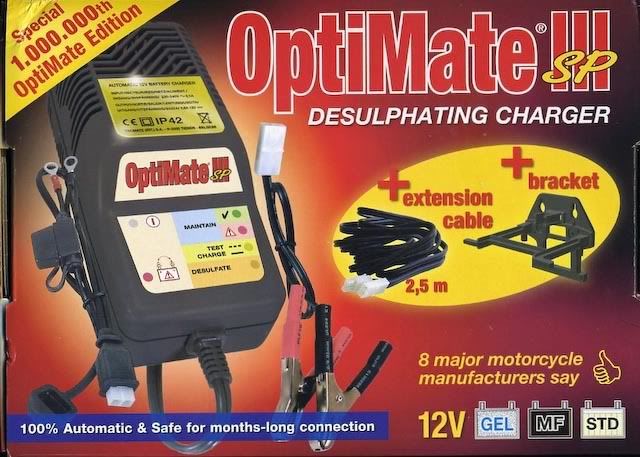
Allan, thanks for steering me in this direction. I ordered one of these Optimate III's over the phone and it was delivered door to door (Northampton UK - Manila Philippines) in under 48 hours.
The unit is so simple it is impossible to balls it up and it works like a charm.
I also ordered the optional BMW socket accessory lead, however this turned out to be unnecessary as the unit is supplied with a fused waterproof pigtail, which you may hook directly to the battery.
The unit also ships with extension leads, wall and window brackets and various adaptors.
I would not hesitate to recommend it. I have already used it on my MF battery (Honda) and my BMW gel battery.